Try to answer the following questions without looking up the answers. There are 25 questions. Each question counts as 4 points. If you miss 3, for example, subtract 12 points from 100 to get a total of 88%. See how well you do. If you want me to grade it, just send me your answers and I'll get back with you.
1. What did God create on Day 4 of creation?
2. What kind of leaves did Adam and Eve use to cover themselves when they realized they were naked?
3. How long did it rain during the Great Flood?
4. What were the names of Noah's three sons?
5. What was Abraham's original name?
6. How old was Abraham when Isaac was born?
7. Name Jacob's oldest and youngest sons.
8. How many wives did Jacob have?
9. When Jacob had a dream of angels going up and down a ladder into heaven, he named the place where he was "Bethel." What does "Bethel" mean?
10. How long were the Israelites in Egypt until God brought them out?
11. What Sea did the Israelites cross on dry land?
12. How long was Moses up on Mt. Sinai getting the Law that God delivered?
13. How many Israelites were sent into Canaan to spy out the land?
14. How many years did the Israelites wander in the wilderness because they refused to go in and take the land of Canaan the first time?
15. Who took over leading the Israelites after Moses died?
16. Who was the first recorded Judge of Israel in the book of the Judges?
17. What significant character trait did the judge Ehud have?
18. Who did God choose as the first king of Israel?
19. How many Philistine foreskins did Saul demand of David in exchange for his daughter's hand in marriage? BONUS: How many did David actually bring him?
20. Who was Solomon's mother?
21. What great atrocity did Jereboam (the first king of the Northern Kingdom) commit which is mentioned throughout the rest of the Old Testament?
22. Who were Daniel's three godly friends?
23. Who was the queen in Babylon who helped save the Jewish people from extinction?
24. Did Nehemiah rebuild the Temple or the walls of Jerusalem?
25. Did Ezra rebuild the Temple or the walls of Jerusalem?
Thursday, June 25, 2009


Wednesday, June 24, 2009
The Last Reading: Revelation 19-22
 We have come to the end of a three-month journey through the New Testament. Did you make it all the way through?
I didn't read EVERY day's material. There were a couple of days when things got crazy and out of hand and I just never got around to it, or I was interrupted and never finished. But the next day I would pick up on that day's reading. So there were a couple of small holes in my reading of the New Testament, but I plan to pick those back up shortly as I continue to read through it again.
This is a HABIT we are building.
There is great strength which comes from this habit. For those who have been on board through the whole process, I know you feel more confident in your Bible knowledge, faith, and in yourself as a Bible reader. Great blessings come from this habit.
Some of you probably started strong the first couple of weeks and then it started slipping. Before you knew it you were just glancing at the posts each day thinking, "I really should get back on track." And you may have tried a few times to jump back in. But you didn't make it a hard-and-fast habit. How do I know this? Because I've done the same thing a thousand times before!
So, how are you going to go forward from today? July is approaching. What will you read in July? Is anyone interested in another schedule, perhaps involving some Old Testament reading? Does anyone want to read a part of the New Testament on a more regular basis with a view toward study? Let me know where your interests lie. Let me know if you thought this process was helpful. Let me know any thoughts you have - I would sure appreciate feedback!
Thanks for your participation. I will continue to post on here as I do my own reading, but we might do something more structured again soon. Stay tuned...
God bless,
Nathan
Tuesday, June 23, 2009
What Is Revelation About?
 We have discussed the fact that John's revelation would "soon take place" (Rev. 1:1), and when John wrote it he said "the time is near" (Rev. 1:3). But that still does not tell us what is the point of the Revelation.
There are two main ideas:
1. Revelation is about God's Judgment against Jerusalem.
2. Revelation is about God's Judgment against the Roman Empire.
Those who suggest it is the judgment against Jerusalem point to verses such as Rev. 7:4-8, which talks about the 144,000 from "every tribe of Israel." Rev. 10:7 says, "In the days of the voice of the seventh angel, when he is about to sound, then the mystery of God is finished, as He preached to His servants the prophets." When was the mystery of God finished? The argument is that it was when God finally judged Israel by destroying Jerusalem. There are also several references in the book of Revelation which seem to parallel some of the language in Matthew 24, in which Jesus is certainly discussing the fall of Jerusalem.
Those who suggest it is the judgment against Rome point to passages such as Rev. 2-3, which are seven letters to seven churches in Asia. Why would these churches be warned about the impending doom of Jerusalem? In fact, a couple of these churches were being oppressed by Jewish influences. Rev. 17 discusses the doom of the harlot woman who sits on the back of a scarlet beast. She is drunk with the blood of the saints, indicating she has been persecuting and killing Christians. "The woman...is the great city, which reigns over the kings of the earth" (Rev. 17:18). What great city reigned at the time? It was undoubtedly Rome. Rev. 18-19 talks about the fall of this city, figuratively described as "Babylon the great." The descriptions found in the chapters are much more easily ascribed to Rome than to Jerusalem.
I must confess I believe the book of Revelation is about God's judgment against the Roman Empire.
What do you think? And why?
God bless,
Nathan
Tomorrow's Reading: Revelation 19-22
Monday, June 22, 2009
When Will Revelation Be Fulfilled?
 Today's reading is Revelation 12-15.
If you read Revelation, you will have this question: When will it be fulfilled? Or when WAS it fulfilled? There the following possibilities:
1. The prophecies of Revelation have already been fulfilled.
2. Some of the prophecies of Revelation have already been fulfilled and some are yet to occur in the future.
3. The prophecies of Revelation are being fulfilled right now.
4. The prophecies of Revelation are yet to occur in the future.
Perhaps you could mix a couple of those possibilities to find a few others, but those are the basic ones. And interpreters of the Bible have fallen into all of those categories in their studies.
One of the greatest teachings in our age is that of pre-millennialism, the teaching that we are living in a period before (pre) the 1000 year reign of Christ (the millennium, interpreted from Revelation 20). So they claim the prophecy in Revelation 20 is yet to come. They claim we are living part of the revelation right now. All of a sudden at some unknown point in time, true believers will be caught up to be with Jesus (raptured), and those who are not believers will be LEFT BEHIND (ever heard of that science fiction series?). Hundreds of clear-headed men and women believe in this interpretation. They have bumper stickers that say, "If this car is unmanned, the Rapture has happened."
What many seem to misunderstand is a time-stamp that JESUS and the HOLY SPIRIT put on the book. Look at the very first verse:
Revelation 1:1 - The Revelation of Jesus Christ, which God gave Him to show to His bond-servants, the things which must soon take place; and He sent and communicated it by His angel to His bond-servant John
And Revelation 1:3 - Blessed is he who reads and those who hear the words of the prophecy, and heed the things which are written in it; for the time is near.
What does "soon" mean? What does "the time is near" mean? Do you think 1000 years is "soon"? Do you think 2000 years goes along with "the time is near"? I can't imagine that it does.
For some perspective, an angel told Daniel to "keep the vision secret, for it pertains to many days in the future" (Daniel 8:26). He was prophesying, at the time, of events which would happen a few hundred years in the future! And God said that was "many days." So when God says the "time is near" and it must "soon take place," I have to believe He is speaking AT LEAST of less than a few hundred years.
I also notice in the letters to the seven churches of Asia (Revelation 2-3) there are many statements which indicate an immediate and impending trial which was about to overtake them.
Even at the end of the book, we read, "Do not seal up the words of the prophecy of this book, for the time is near" (22:10); and "I am coming quickly" (10:12, 20).
Let us interpret Scripture within the time-frame given by God. In my next post, I'd like to discuss a couple of real possibilities as to WHEN the Revelation was fulfilled.
God bless,
Nathan
Tomorrow's Reading: Revelation 16-18
Saturday, June 20, 2009
John's Revelation Is Important
 The Revelation of Jesus Christ to the apostle John is an Important Book.
Many in today's religious world might say it's THE most important book in the New Testament. They claim it has direct and immediate impact upon us because we are living RIGHT NOW in the culmination of its prophecy. "The signs of the times are happening all around us," they say. "You can tell the end is near because of all the war, violence, and crime." But, as we will see in some future posts, the prophesies in Revelation have largely already been accomplished. If they have already been accomplished, then how is it important to us? Because it is a revelation given by the Holy Spirit
All Scripture is inspired by God and profitable for teaching, for reproof, for correction, for training in righteousness; so that the man of God may be adequate, equipped for every good work (2 Timothy 3:16-17). Revelation is Scripture and is profitable for all these things. If we are to know God's word, we should know Revelation. We should not pass it off as "too difficult" or as something that doesn't apply to us today. It absolutely applies in many ways! We learn much about God's fight with Satan in the spiritual realm. We learn how the prayers of God's children move Him. We learn about the sovereignty of our great God - He is in control! And many other lessons...
So, let us be careful in our studies of this book, but let us STUDY the book.
Next week, I hope to initiate conversations on a few major points of study in the book of Revelation.
May God bless you as you read it.
Nathan
Monday's Reading: Revelation 12-15
Thursday, June 11, 2009
John 4-6: Jesus Gets In Your Face
 Sometimes Jesus says things like, "My yoke is easy, My burden is light. Come to Me, all you heavy laden, and I will give you rest." He said in John 3:16, "For God so loved the world, that He gave His only begotten Son, that whoever believes in Him shall not perish, but have eternal life." So a picture is formed of the Savior. He is gentle. He has long, flowing hair. He has a beautiful white robe that never gets dirty. He has a glowing halo around His head. Children flock to Him in droves to sit on His knees and listen to His stories. He smiles a lot and hugs a lot.
Have you been sold that version of the Savior?
John 6 (and other passages) gives a slightly different picture. Sure, it starts out with Jesus, in compassion, feeding the crowd of 5000 with five barley loaves and two fish. But what transpires next may destroy the image of the weak, politician-style, often effeminate version of our Lord.
The people find Jesus in another place by the Sea of Galilee and try to get Him to produce food for everyone again. I had to laugh as they tried to be sly with the Lord. "What work do You perform?" they asked. "Our fathers ate the manna..." as if to say, "Oh, wait, here's an idea that just popped into my head - God gave the Israelites manna in the wilderness...maybe YOU could produce miraculous food, too, and that would PROVE you are God's Son and we'll believe in You." Jesus didn't buy it. He refused to feed this crowd which was now out looking for a handout. He fed them when they weren't expecting it, but He wasn't in the food business. He was in the soul business.
He proceeded to preach one of the hardest sermons of His earthly career. He said they must eat His flesh and drink His blood, intentionally speaking in difficult and cryptic language in order to sift those who wanted to REALLY understand His words and those who were merely out to hear interesting stories and possibly see an amazing miracle. "As a result of this many of His disciples withdrew and were not walking with Him any more" (John 6:66).
What would YOU have done? In order to prove that you had an honest, seeking heart, what should you have done? You should have done what the apostles did. Jesus asked if they would leave too. Peter said, "Lord, to whom shall we go? You have words of eternal life. We have believed and have come to know that You are the Holy One of God." (John 6:68-69).
Jesus gets in our face. He confronts us, tests us, challenges us. Following Him is no picnic. Of course, neither is trying to make our own way in this sinful world! It may be difficult sometimes, but it is so rewarding. But you have to WANT to!
God bless,
Nathan
Tomorrow's Reading: John 7-9
Wednesday, June 10, 2009
John 1-3: Jesus - Judge or Savior?
 How would you prove from Scripture that Jesus didn't come as a judge? He loves us so much, after all, that He wouldn't want to see anyone hurt. Certainly an all-loving Savior couldn't send anyone into HELL, could He? It's so great to have verses such as John 3:16-17 to give us a proof-text for this thought!
"For God so loved the world, that He gave His only begotten Son, that whoever believes in Him shall not perish, but have eternal life. For God did not send the Son into the world to judge the world, but that the world might be saved through Him."
Isn't it comforting to know God doesn't want to judge the world? We swell with joy when we see that God sent Jesus to save the whole world! That means all men, right? He's not a judge, but a Savior!
But wait... What about the next couple of verses? But why read on, if we already have what we want out of the Scriptures? I'd hate to read on to discover what I THOUGHT was incorrect! But God doesn't care about what I WANT - He cares about what is RIGHT. And if I have a heart for God and what is right, I should read on. I should take ALL of what God says on a subject, not just rip a couple of verses out of context.
John 3:18
"He who believes in Him is not judged; he who does not believe has been judged already, because he has not believed in the name of the only begotten Son of God."
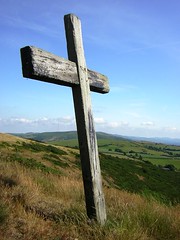 Really, verse 16 said this clearly ("whoever believes in Him shall not perish"). But verse 18 (in fact 18-21) drives the point home. Jesus did not come to earth in the capacity of Judge. He came as a Savior to offer salvation to the entire world. He did not come to EXECUTE judgment, but to speak words by which we will be judged one day (John 12:48).
When it boils down, Jesus left our salvation UP TO US, in a sense. His resurrection holds the POWER of salvation and the OPPORTUNITY of salvation, but to actually take hold of that salvation takes FAITH - believing that He is the Son of God, the only begotten of the Father.
Have you taken hold of salvation? Do you believe? Jesus came so that we might have faith in Him. Men who have no faith can obtain faith. Men who have little faith can have their faith strengthened and fortified so they will never fall away. But we must have a desire for it. Do you want it?
God bless,
Nathan
Tomorrow's Reading: John 4-6
Tuesday, June 9, 2009
3 John: No Greater Joy
 Beloved, I pray that in all respects you may prosper and be in good health, just as your soul prospers. For I was very glad when brethren came and testified to your truth, that is, how you are walking in truth. I have no greater joy than this, to hear of my children walking in the truth. (3 John 2-4)
Darryl lay in his bed, an old man, knowing his end was near. A friend sat next to him, chatting about this and that. His friend asked, "So, what makes you the happiest as you look back on your life?" What do you think Darryl might say? What might you say?
Was it all the times you bought a lottery ticket...hoping for that big win?
Was it the big house you were able to afford?
Was it the amazing car, motorcycle, or boat you had in your driveway?
Was it the fact you were the top-dog over a bunch of folks at work?
Was it the great book, poem, or song you wrote?
Was it spending time with your wife and kids?
Was it a special friend?
Was it the times you had in prayer with God?
--- What makes you the happiest on this earth? ---
John said he had "no greater joy" than to hear of his children walking in truth! These were not children of the flesh, but of the Spirit. They were men and women he had helped convert with the gospel of the Lord. They had taken hold of that gospel and had never let go. They were grounded in truth. They clinging tenaciously to their pearl of great price.
When I come to the end of my life, I will probably find the greatest joy (or the greatest heartache) in how my children turn out. If the Lord grants me success instilling a faith and a love for the truth in their hearts, I will consider myself truly blessed! And as I am able to help others come to the truth, when I hear of their continued faith, I will rejoice! There is unparalleled joy in faithful children. Right, Dad?
What joy do you think GOD feels when His children walk in the truth?
God bless,
Nathan
Tomorrow's Reading: John 1-3
Monday, June 8, 2009
1 John: What Can You KNOW?
 John, the apostle and author of this letter addressed, it seems, to Christians in general, was battling a group of men called "gnostics." You may have heard of the term "agnostic," which means "without knowledge." An agnostic believes it's impossible to truly KNOW about God or the spiritual world. He might concede that the spiritual realm exists, but would argue that we have no real way of understanding the spiritual world. This absolves him (in his mind) of any responsibility he may have towards the spiritual world.
The word "gnostic" means, simply, "knowledge." A gnostic is someone who believes he has special knowledge regarding the spiritual realm. During the time John wrote his letters, this religion was not a full-blown, named religion, but it was on the rise. It would become full-blown in the second and third centuries, and it's alive and well today.
A Calvinist is one of these claiming special knowledge. He claims that no one may become a Christian in the first place unless God plants the special knowledge in one's heart. He claims man is incapable of thinking on a spiritual level until God saves him and changes his thinking. Isn't this salvation through special knowledge?
Anyone believing in "special revelation," the idea that God continues to reveal bits and pieces of His will to us today in an ongoing revelation, is a gnostic. He puts his faith in special knowledge revealed only to him - not to the rest of the world.
John wrote that we may KNOW we have eternal life. Who cares what these "special revelation" guys claim? Who cares about their hifalutin, inflated views of their own knowledge. John says the average person can KNOW he is saved. "By this we know we have come to know Him, if we keep His commandments" (2:3). "I have not written to you because you do not know the truth, but because you do know it" (2:21). "If you know that He is righteous, you know that everyone also who practices righteousness is born of Him" (2:29). "We know that when He appears, we will be like Him because we will see Him just as He is" (3:2). "You know that He appeared in order to take away sins; and in Him there is no sin" (3:5). "By this the children of God and the children of the devil are obvious: anyone who does not practice righteousness is not of God, nor the one who does not love his brother" (3:10). "We know that we have passed out of death into life, because we love the brethren" (3:14). "...you know that no murderer has eternal life abiding in him. We know love by this, that He laid down His life for us" (3:15-16). "We will know by this that we are of the truth, and will assure our heart before Him" (3:19). "We know by this that He abides in us, by the Spirit whom He has given us" (3:24).
Okay, we could go on and on with this...there are many more verses with the same thought and impact as those above, but you get the idea. John wants us to KNOW that we can KNOW we are saved, that we are in Christ, that we are abiding in Him, etc. We should never doubt this fact. We should be able to apply simple tests to ourselves and discover whether or not our hearts are in the right place. It's not rocket science! It's not by special revelation. It's through the revelation that every person today may pick up and read for himself.
And that gives me great confidence!
God bless,
Nathan
Tomorrow's Reading: 2 & 3 John; Jude; Philemon
Thursday, June 4, 2009
Matthew 18-21: Forgive and Forget?
 How many times have you heard the phrase "forgive and forget"? There is something to the phrase, but it may be slightly misleading. As I read through Matthew 18:21-35 today, I noticed an interesting perspective on forgiveness. Jesus told the story of a king settling accounts with his slaves. One slave pleaded and begged not to be thrown into prison. He owed 10,000 talents, roughly equivalent to 150,000 YEARS of normal wages. There was no way he would EVER pay that back! But the king had compassion upon his servant and forgave him the whole debt.
This is a story that grabs the hearts of men. We are interested when someone wins a million dollars. "How will he spend it? What will he do with his new life, now that he has no debts to trouble him? I wish I was in his position. I would be able to help so many people if I had money. I would be a much better person, if I didn't have the constant worry of making a living. Oh, to be completely debt free!"
Now that Jesus has our full attention, He proceeds to demonstrate the ruin of this servant. Instead of becoming a better person, he went out to find another servant who owed him only 100 danarii, roughly 100 days of normal wages. This was certainly a debt, but it could be paid back within a few months. But the servant had no forgiveness for his fellow. He threw him in prison, demanding everything be paid in full.
What I find interesting is how the king responded. He had forgiven this servant. He had wiped away the debt. But when the servant showed no intention of forgiving his fellow servant, the king threw him in prison and REINSTATED HIS OLD DEBT. Jesus was drawing a marked parallel between this king and God, for He concludes: "My heavenly Father will also do the same to you, if each of you does not forgive his brother from your heart" (Matthew 18:35).
When God says, "I will remember your sins no more" (Jer. 31:34; Heb. 8:12; 10:17), I think the true meaning is: "I will remember your sins against you no more." It's not as if the sins never existed. God still knows I sinned. God forgave David for his sin with Bathsheba, but He still recorded it in Scripture! He certainly remembered the sin, but He does not remember the sin AGAINST David any longer. David was forgiven.
If, after God forgives us, we then refuse to forgive our neighbor and brother, God will hold us accountable for all those sins that we have committed in this life. God forgives us only as we forgive others. Kind of scary, huh? But if we are to be God's children, we must act like Him!
God bless,
Nathan
Tomorrow's Reading: Matthew 22-25
Wednesday, June 3, 2009
Matthew 14-17: Galilee
 Jesus grew up in Galilee and the greater part of His ministry centered in this land - in the cities and countryside surrounding the Sea of Galilee.
His base of operations was in Capernaum, which is on the north of the Sea.
In our reading today, Jesus fed the 5000 in some hills beside the Sea.
Genessaret was just to the south-west of Capernaum, also on the Sea. This was the city where Jesus and His disciples landed after He and Peter walked on the water (Matt. 14:34).
Tyre and Sidon are on the coast of the Mediteranean Sea, to the north-west from Galilee. This is where Jesus had the discussion with the Canaanite woman in Matt. 15:21-28.
He then returned to the Sea of Galilee and fed the 4000 somewhere in the surrounding mountains (Matt. 15:29).
After sending the crowds away, Jesus took a boat to the region of Magadan, which was on the west side of the Sea. I believe Magdala and Tiberias are in that area. Magdala is where Mary Magdalene was from.
Jesus then went to the district of Caesarea Philippi, which was well to the north. This was where Peter made his great confession that Jesus was the Christ, the Son of the living God (Matt. 16:13-20). Because of the proximity of Matthew 17 to the events just preceding in chapter 16, it is often thought the Transfiguration (Matt. 17:1-13) happened somewhere close to Caesarea Philippi, but no one knows for sure.
At the end of our reading today Jesus arrived back in Capernaum (Matt. 17:24).
Seeing the actual places where Jesus went on His journeys gives us a greater understanding of how He ministered and a better picture of His work. It can also serve to show us how REAL His earthly ministry was, as we see concrete places - cities, mountains, regions, lakes. We understand Jesus was a real person rooted in history.

God bless,
Nathan
Tomorrow's Reading: Matthew 18-21
Tuesday, June 2, 2009
Matthew 11-13: Jesus Respects My Intelligence!
 I'm now living near a center of Catholicism: New Orleans. It has been interesting to discover some of the teachings of the Roman Catholic Church. One of their foundational beliefs is "common" people cannot understand the Bible for themselves. The "clergy" interprets Scripture for the "layman." Thus, private Scripture reading and spiritual growth is discouraged.
I have a question for them: Who gave the "clergy" the ability to understand the Scriptures, and why am I (as a layman) not given this same privilege?
Jesus prayed: "I praise You, Father, Lord of heaven and earth, that You have hidden these things from the wise and intelligent and have revealed them to infants. Yes, Father, for this way was well-pleasing in Your sight" (Matt. 11:25-26).
Doesn't Jesus teach exactly the opposite of what the Roman Catholic Church teaches? Who did Jesus teach? He spoke with the common people. He did not go to the Pharisees and Scribes. He said the Physician goes to those who are sick. His teaching is understandable by every man.
I also noted the WAY He taught in these three chapters. John's disciples posed a question in Matt. 11:3 - "Are You the expected one?" Jesus did not say "Yes" or "No." He said, "Go and report to John what you see and hear" (Matt. 11:4). Why did He not just give them a straight-up answer?
When the Pharisees challenged His disciples about eating grain on the Sabbath day, Jesus didn't just say, "I know what I'm doing; stop pestering My disciples." He said, "Have you not read...?" He REASONED with them from the Scriptures. Then they questioned Him again: "Is it lawful to heal on the Sabbath?" (Matt. 12:10). Jesus, again, did not simply say, "Yes." He gave them something to chew on: "It is lawful to do good on the Sabbath," He said (Matt. 12:12), and proceeded to heal a man's withered hand.
Jesus made people THINK. He did not give pat answers. He did not do their thinking for them. He spoke so often in Parables (Matt. 13), which were meant to make the hearers DIG for the meaning. Jesus respects the intellect of the common man! He wants us to follow His teaching to the correct conclusions by discovering spiritual principles.
And it's so interesting so many of these big-shot, big-name, wealthy men and women MISS His main points completely.
God bless,
Nathan
Tomorrow's Reading: Matthew 14-17
Monday, June 1, 2009
Matthew 8-10: Public Preaching
 Jesus said this to the twelve disciples before He sent them out on their first preaching tour:
"What I tell you in the darkness, speak in the light; and what you hear whispered in your ear, proclaim upon the housetops. Do not fear those who kill the body but are unable to kill the soul; but rather fear Him who is able to destroy both soul and body in hell" (Matt. 10:27-28).
Jesus had been teaching them secretly, privately. But He encouraged them to go public with the message of the kingdom of heaven. This is in the midst of a warning not to fear what folks might say or do. Why would there have been the temptation to fear?
When we boldly proclaim God's word "upon the housetops," the world will call us crazy, demon-possessed, and worse. When we teach what Jesus said about moral issues (fornication, marriage, honesty, etc.), we become the enemy of the world. Therefore, Jesus bolsters our courage by saying, "So do not fear; you are more valuable than many sparrows" (Matt. 10:31).
And it's not IF we get around to publicly proclaiming God's word - it's WHEN we do it. Jesus wants this done. We should have no trouble, in our "free" state, proclaiming Jesus publicly. What's the worst that can happen? Ridicule? Charged with "hate speech" crimes? We can allow imagined possibilities to paralyze us, or we can fear God more than more than we fear man. Let's get out and spread the word! These twelve disciples got out and spread the word in a society much more hostile to their message. Surely we can honor our Lord in this way!
Lord, please help us have the courage to go public with our faith.
God bless,
Nathan
Tomorrow's Reading: Matthew 11-13
Friday, May 29, 2009
Matthew 1-4: Why Was Jesus Baptized?
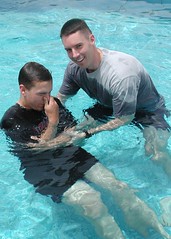 This has puzzled me many times. Jesus said He needed to be baptized to "fulfill all righteousness" (Matt. 3:15), but what does that mean? He did not have sin which needed to be washed away. He did not need to be buried with Christ (Rom. 6:4) because He WAS Christ. So why did He submit Himself to the baptism of John?
1. To fully submit to the Father's will. John said to Jesus, "I have need to be baptized by You, and do You come to me?" (Matt. 3:14) He recognized this as an act of submission. Jesus submitted Himself before His Father through His baptism.
2. As an initiation ceremony; an anointing. This was the beginning of His main ministry. He was thirty years old, the age when Hebrew men began to gain respect because of their age. Everything was in place for His earthly work. His baptism, accompanied with the Father's voice, "This is My beloved Son, in whom I am well-pleased," (Matt. 3:17) and by the Holy Spirit lighting upon Him in the form of a dove anointed Him as the Son of God and the chosen one for a special work.
3. As an example for His followers. Jesus asks us to do only those things He has already done. He asks for full submission - He fully submitted. He asks for love - He loved to the greatest degree. He asks for baptism - He submitted to baptism.
Let me know if you have some other reasons you can think of for Jesus' baptism.
God bless,
Nathan
Tomorrow's Reading: Matthew 5-7
Thursday, May 28, 2009
Galatians: The One Gospel
 "That's YOUR interpretation..."
"You see it YOUR way, I see it mine."
"Go to the church of YOUR choice."
"There are many roads that lead to heaven."
Have you heard any of these statements before? Each one of these shows a complete misunderstanding of the Lord's message. Galatians is very clear: Jesus came to give us ONE GOSPEL, and there is no other way to get to heaven. In fact, there are many FALSE ways which mislead many. Paul wrote, "I am amazed that you are so quickly deserting Him who called you by the grace of Christ, for a different gospel; which is really not another; only there are some who are disturbing you and want to distort the gospel of Christ" (Gal. 1:6-7). He didn't say, "I'm amazed you are deserting the gospel or the church - he said they were deserting GOD! They distort, obscure, obfuscate the real gospel. It's not a completely new gospel they preach, but a bastardization of the original.
How many false gospels are there now? After 2000 years, men have come up with all kinds of crafty ways to distort the gospel of Christ. It's tough to see the truth sometimes amidst all the traditions of men. Paul said those who preach a different gospel are "to be accursed" (Gal. 1:8-9).
The main false teachers he accused were Jews who were trying to force Gentiles to be circumcised (in keeping with the Old Testament law). Paul had some pretty tough things to say to those Judaizing teachers and those who would follow them:
"You foolish Galatians, who has bewitched you...?" (3:1)
"Are you so foolish? Having begun by the Spirit, are you now being perfected by the flesh?" (3:3)
"if you receive circumcision, Christ will be of no benefit to you...You have been severed from Christ, you who are seeking to be justified by law; you have fallen from grace." (5:2, 4)
"I wish that those who are troubling you would even mutilate themselves." (5:12) This is my personal favorite. He could be saying, "They want to circumcise so much - I wish they would circumcise themselves and I hope the knife slips!" Or, perhaps more appropriately, he could be saying, "They are so interested in cutting things off, I wish they would cut themselves off of the group there!" Either way, it's scathing.
I think we'd better stick to the ONE gospel revealed by Christ and His apostles!
God bless,
Nathan
Tomorrow's Reading: Matthew 1-4
Wednesday, May 27, 2009
James: The Rich Serving the Poor
 I didn't remember just how much James had to say about the rich and the poor (James 1:9-11, 26-27; 2:1-7, 14-17; 5:1-6). James 1:9-11 leaped out at me today:
9 But the brother of humble circumstances is to glory in his high position;
10 and the rich man is to glory in his humiliation, because like flowering grass he will pass away.
11 For the sun rises with a scorching wind and withers the grass; and its flower falls off and the beauty of its appearance is destroyed; so too the rich man in the midst of his pursuits will fade away.
How is a poor man in a high position? And how is a rich man in humiliation? And why should they glory in their positions? As Alice would say, "Curiouser and curiouser."
There are brethren in Zimbabwe who are literally dirt poor. They have no high position...at least on earth. And that's the point. GOD puts them in a high position in His kingdom. God does not distinguish by class, race, sex, or any physical trait. The poor man will sit on a throne as high as any rich man when we enter into eternal life.
Those who minister to the Zimbabwe brethren are rich, at least in comparison. We are rich! And yet, we are to glory in our humiliation. We are to revel in the fact that we are not one bit better than our poor brethren. In fact, God has given us a greater responsibility to serve those brethren, to place ourselves in a lower place. What a great opportunity!
We all will fade away shortly. Let's serve each other while we have the chance.
God bless,
Nathan
Tomorrow's Reading: Galatians
Tuesday, May 26, 2009
2 Corinthians 8-13: Church Cooperation
 The PATTERN under Christ's new covenant for local assemblies is autonomy. An "automaton" is a self-operating machine. It contains within itself everything it needs to function. We say something is "automated" when it can do its work by itself. A church is "autonomous" because God has given each assembly what is necessary for it to function properly within itself. God did not set up a system of big churches and little churches (although, if He had, I think money would probably flow from the bigger churches to support the little churches, instead of the opposite systems we see today). Each church, irrespective of size, can and should function independently.
2 Corinthians 8:18-19 is one of the rare occasions (perhaps the only occasion?) where we see a level of church cooperation in a specific task. Brethren in Judea were hungry because of famine, so churches throughout Asia were sending money for their relief. (This is similar to the situation now in Zimbabwe. Many churches and individuals are sending help because of the famine, which affects hundreds of Christians in many areas of that country.) In this verse, we find that the "churches" appointed Titus to carry their money down to Judea.
 We can learn each church trusted Titus. What a great vote of confidence that all the churches were comfortable with him as a messenger!
We can learn each church gave money.
We can learn the churches did NOT send money to a "sponsoring church," who then forwarded the money to Judea. No, each church operated independently, though they sent the money through one messenger. The idea of a sponsoring church is not found within the pages of the New Testament.
There is a certain level of church cooperation found in Scripture, but it falls far short of what so many have done today. There was not banding together of groups of churches for some big project. There was no "mother church" which oversaw smaller child churches. There were assemblies, each having their own responsibility to the work God had given.
Do you see that as the pattern?
God bless,
Nathan
Tomorrow's Reading: James
Monday, May 25, 2009
2 Corinthians 1-7: Marrying a Non-Christian
 We know it's not a SIN to be married to a non-Christian, because Paul gives instruction on that subject in 1 Corinthians 7. But towards the end of the chapter (1 Corinthians 7:39), Paul said widows could remarry - but "only in the Lord." A widow should only marry a Christian. Perhaps 1 Corinthians 7 is concerned with men and women who obey the gospel but their spouses don't. Perhaps they became Christians only AFTER choosing a mate.
A passage in today's reading (2 Corinthians 6:14-15) has been used to say Christians should ONLY marry Christians. Here is the passage:
14 Do not be bound together with unbelievers; for what partnership have righteousness and lawlessness, or what fellowship has light with darkness?
15 Or what harmony has Christ with Belial, or what has a believer in common with an unbeliever?
I believe the immediate context of these verses indicate God is calling Christians to come out of the world. We are not to associate ourselves with worldly practices. We are not to run in worldly circles or extend the hand of fellowship to the world in the sense of participating in worldly matters.
So, can that apply to marrying a non-Christian? Think about it: what are we saying when we decide to marry someone who does not hold our faith? WHY are we marrying a non-Christian? Here are a few reasons.
1. He / She is really cute, fun, exciting, and makes me feel good. Isn't this a reason why we end up liking people? But these are external attractions, which may have nothing to do with the heart of the individual.
2. He / She makes a lot of money. Here is a reason based upon financial security. Again, it has nothing to do with the person's heart.
3. He / She has a great heart. A great heart for what? Does the person love other people? Does the person love God? If he or she loved God, don't you think there would be obedience rendered?
And we could list many other reasons...
We TRADE our faith for something else we like. We TRADE Jesus for a cute girl. We TRADE our faith for financial security. We TRADE God's picture of a good heart for our own picture. Is that really worth it? More importantly, is that spiritual thinking or carnal desire?
Of course, we can cite many stories of non-Christians who later became Christians because of their spouse's influence. But I'll bet we can cite many MORE stories of Christians who have fallen away because of unbelieving husbands and wives. Marriage is a big deal. We bind ourselves together FOR LIFE to another person. ONE person will have more influence over our decisions for the rest of our lives. Who should that be? If we are a single Christian, we have the opportunity to make a great decision on a spouse...who shall we choose?
Let me know what YOU think.
God bless,
Nathan
Tomorrow's Reading: 2 Corinthians 8-13
Thursday, May 21, 2009
1 Corinthians 5-9: To Marry Or Not To Marry
 Paul's teachings on marriage in 1 Corinthians 7 may be considered as difficult sometimes, especially to those who would pit Paul's teachings AGAINST the teachings of Jesus (i.e. Matthew 5:31-32; 19:1-9). But Paul does not teach anything different than Jesus had taught, except in encouraging those at the time NOT to marry "in view of the present distress" (1 Cor. 7:26). There would be severe persecution coming against Christians, and Paul encouraged those who were not bound to a husband or wife to stay celibate to limit later heartache. After all, who would want to see a husband, wife, or children tortured and / or killed? But Paul was not COMMANDING celibacy, only encouraging it.
1. Marry if you must (7:1-9). If you are burning with desire, you may need to be married so you can fulfill that desire in the God-given way. Marriage is the ONLY provision God has given for us to have a sexual relationship.
2. Don't divorce a mate (7:10-24). Some might have gotten the impression that Paul wanted them to leave their mate to be in a better position to serve God. Paul said, "the wife should not leave her husband" (7:10). And when Paul said "leave," he meant divorce, because in 7:11 he said if she DOES leave "she must remain unmarried," showing the marriage had been terminated. Paul follows that up with, "and...the husband should not divorce his wife." This is in complete harmony with Jesus' teaching. He shows in 7:12-24 that a wife should not even leave an unbelieving husband. If the husband wants to leave, she can't force him to stay...but she still must remain unmarried.
3. You don't HAVE to marry (7:25-35). Don't feel that God has commanded Christians to marry. In fact, a single man or single woman can serve God in ways a married individual cannot. "One who is unmarried is concerned about the things of the Lord, how he may please the Lord; but one who is married is concerned about the things of the world, how he may please his wife, and his interests are divided" (7:32-33). That doesn't mean a married man cannot serve God effectively, but he cannot serve God in complete freedom because he has a wife (and possibly kids) to think about, too.
4. Marriage is still good (7:36-40). If a man decides to give his daughter away in marriage, that's fine. It's not a sin. Paul is not binding anyone to celibacy, he's only encouraging it as a wise choice. If a widow wants to remarry, more power to her (as long as she marries "only in the Lord," which I think means a Christian man).
Me? I fall into category #1, I'm afraid. I HAD to get married. And I'm glad I did :-) But it's not mandatory.
God bless,
Nathan
Tomorrow's Reading: 1 Corinthians 9-12
Wednesday, May 20, 2009
1 Corinthians 1-4: Do You Care What Others Think About You?
 Are you the personality that thrives on what others think about you? When others praise you, does that charge your batteries? When they criticize, does it destroy you?
If you've read the book, The Five Love Languages, you'll know what I mean when I say my main love language is "words of affirmation." When I am praised it means a lot to me. I have to be careful not to be puffed up with pride. But I also must be careful not to fall into depression when I am criticized. Perhaps you know what I mean.
Paul's words in 1 Corinthians 4:3-4 mean a lot to me: "But to me it is a very small thing that I may be examined by you, or by any human court; in fact, I do not even examine myself. For I am conscious of nothing against myself, yet I am not by this acquitted; but the one who examines me is the Lord."
1. Paul didn't care how others judged him. "I am rubber, you are glue...words bounce off me and stick on you." Okay, maybe he wouldn't say that, but the background thought is there. Who is another man to judge me? Does any man or woman on the face of this earth have the authority to judge me in my actions? No! They may point things out. They may try to guide me in certain directions. But they are not the final say.
2. Paul didn't even judge himself. Do I have the authority to say, "I'm doing well"? Can I judge myself as a worthy citizen of the Kingdom of Heaven? Paul didn't. I shouldn't.
3. Paul allowed only the Lord to judge him. When God tells me I'm missing the mark, the voice of authority has spoken! If I'm a "words of affirmation" guy, I need to look forward to GOD'S PRAISE and not worry so much about man's. I need to pay special attention to GOD'S CRITICISM, not man's. He judges.
God bless,
Nathan
Tomorrow's Reading: 1 Corinthians 5-8
Tuesday, May 19, 2009
1 & 2 Thessalonians: Working With My Hands
 What is a Christian's work? Am I supposed to be out on the street corners shouting at passers-by all the time? Should I be organizing political rallies against the latest moral outrage in the nation? Should I be intentionally causing an uproar in my community to get people to notice my church?
Paul lays it out nicely and succinctly for us in 1 Thessalonians 4:10b-12: "But we urge you, brethren, to excel still more, and to make it your ambition to lead a quite life and attend to your own business and work with your hands, just as we commanded you, so that you will behave properly toward outsiders and not be in any need." Paul told Timothy to instruct them men to pray for all those who are in authority, "so that we may lead a tranquil and quite life in all godliness and dignity" (1 Timothy 2:2).
The Christian is not supposed to be a trouble-maker. I am not commanded to make waves. I am commanded to follow Jesus' example, which might result in some waves, but that's not my intent. My intent is to lead a quiet life.
And I should be working with my hands. I should be doing something to make money. Christians are not leeches. Sometimes a disciple of Christ will fall into some need, and his brethren will help pick up his slack for a little while. The one who eats someone else's bread without paying for it and who does not work hard NOT to be a burden to others is not following the example of Paul and the apostles. Paul said, "If anyone is not willing to work, then he is not to eat, either" (2 Thessalonians 3:7-10). That doesn't sound like our society today. People call the church building all the time to ask for help paying rent, their utility bills, food, etc. Their vision of the church is a charity organization. But Paul was very clear about this - you better be working in what you can do!
So all of us who are working today: we are doing exactly what a Christian ought to be doing. Let you lights shine, my friends.
God bless,
Nathan
Tomorrow's Reading: 1 Corinthians 1-4
Monday, May 18, 2009
Romans 14-16: Did I Make a Brother Stumble?
 What would make a brother stumble today, in the sense Paul discussed in Romans 14? We can easily see the Jews not wanting to eat certain meats, while the Gentiles might throw a barbecue with no violation to their consciences. We can see the Jews observing special days (resting on the Sabbath, celebrating the Passover, etc), while the only special days the Gentiles had were pagan and obviously sinful.
A Gentile could become a stumbling block to the Jew by bringing a big loaf of leavened bread over during the Feast of Unleavened Bread. The Gentile might say, "Brother Jew, you know these old customs of your old law are no longer in force. Why don't you dig in to this wonderful loaf with me to prove it." And the Jew might follow suit. There would be nothing sinful about the action...except that the Jew would FEEL like he was forsaking his God. It would bother his conscience, because he has NEVER eaten leavened bread during this special feast in his entire life!
Paul's point to the Gentile is, leave Brother Jew alone! If he has such trouble with this, allow him time to come around. When he purges his house of leaven during the special feast week, he is doing that towards his God. Don't make him stumble; don't make him violate his conscience.
Years ago, I was driving my wife, my brother and sister-in-law, and a Zulu lady from South Africa up to Virginia for a wedding. On the trip, we opened up our Harry Potter book and began reading. Harry Potter is a fantasy book about wizards, giants, flying broomsticks, dragons, and all kinds of weird creatures. It also has some dark elements to it in the fight of evil vs. good. As we were reading the book out loud, it suddenly occurred to me that the Zulu lady may have some real problems with this book! She was raised in a society where there were witch-doctors, praying and sacrificing to ancestors, occult-ish rituals, etc. But we had just plunged right in to this fantasy novel without thinking about her. Was she thinking, "This stuff is really bad. I can't believe my brothers and sisters would read this. Well...maybe it's okay, since these are Christians... I'll just go along with it and not say anything." But maybe it hurt her conscience.
Now I understand there is much controversy over these books. I'd be glad to offer my opinion, if anyone wants to know. But I completely respect the family who decides not to participate in such types of literature. And I need to be careful not to push my own OPINIONS upon my fellow Christians in such a way as to push them to take part in something they would FEEL is wrong. Because if they FEEL it's wrong, it IS wrong to them!
God bless,
Nathan
Tomorrow's Reading: 1 & 2 Thessalonians
Friday, May 15, 2009
Romans 6-9: God Chose Gentiles - Jews, Get Over It!
 Romans 9 is sometimes taken out of context to "prove" that God chooses individuals for salvation at His whim, regardless of obedience.
God chose Abraham because of his faith (already shown in chapter 4). But not all descendants of Abraham were descendants of promise (9:6). Ishmael, from whose loins came the Muslim people, was not the child of promise - God chose Isaac.
Not all of Isaac's descendants were children of promise, either. God chose Jacob over Esau before they even left their mother's womb. The choice was not based upon righteousness or wickedness (9:11-12).
So, Paul raised the question: Are you going to challenge God's choice on these matters? "No!" the Jew would reply. After all, he was one of the chosen one's, being an Israelite.
But Paul's big point is at the end of the chapter.
Romans 9:22-24
22 What if God, wanting to show His wrath and to make His power known, endured with much longsuffering the vessels of wrath prepared for destruction,
23 and that He might make known the riches of His glory on the vessels of mercy, which He had prepared beforehand for glory,
24 even us whom He called, not of the Jews only, but also of the Gentiles?
Paul's point is this: God has now chosen Gentiles to be included in those who "He had prepared beforehand for glory." Jews need to understand this, and get over thinking they are God's ONLY chosen, special people. Likewise, in chapter 11, Paul will tell the Gentiles not to get a big head just because God has cut off some of the Jews and grafted them in.
I better not get the big head, either, like the Pharisee thanking God that he wasn't like that sinner over there. I'm saved only by God's grace. It's not by any power of my own. It's not because I'm special because of who I am. It's because God is special and He saved me!
God bless,
Nathan
Tomorrow's Reading: Romans 10-13
Thursday, May 14, 2009
Romans 6-9: Where Do You Start Teaching Somebody?
 One of the reasons we FREEZE UP and don't ask friends and neighbors to study the Bible is: We don't know where we would start teaching. The problem is, everyone is on a different page. Some don't believe in God. Some believe in the God of the Old Testament, but not in Jesus Christ or the Holy Spirit. Some believe in Allah. Some in Buddha. Some believe in the Father, Son, and Holy Spirit, but they have been taught an incorrect view of what God requires from them. Some are very religious but still lost.
Where do you start?
Paul started with SIN in Romans. Think about that. Gentiles didn't have such a problem with this, because they KNEW they were stinking sinners. They KNEW they had come out of idolatry, fornication, blasphemy, etc. And the Jews nodded their heads smugly. All THEY had to do was step out of Judaism and into Christianity. They didn't have to change Gods. They felt like they didn't have to change a thing. But Paul very carefully set them up in Romans 1-3. He showed how bad the Gentiles were and then dropped the bomb on the Jews in Romans 2:1: "Therefore you have no excuse, everyone of you who passes judgment, for in that which you judge another, you condemn yourself; for you who judge practice the same things."
He says, "What then? Are we [Jews] better than they [Gentiles]? Not at all; for we have already charged that both Jews and Greeks are all under sin..." (Romans 3:9). And again, "all have sinned and fall short of the glory of God" (Romans 3:23).
The FIRST step in coming to God is realizing there is a moral standard, there are rules set by the Creator, and we have missed the mark! Not only have we sinned, but the consequences of the sin are (1) a complete separation from God, the source of life, and (2) Jesus, God's Son, had to suffer, bleed, and die because of it. I'm sure we could come up with a huge list of consequences if we wanted.
So...thinking about teaching your neighbor? You need to somehow show him that he's a sinner. Don't ram it down his throat as if you are blameless. He needs to know YOU have fallen just as far as he. He needs to know the only material difference between a Christian and an unbeliever is the fact that the Christian has been washed by the blood of Jesus Christ and been forgiven!
God bless,
Nathan
Tomorrow's Reading: Romans 6-9
Wednesday, May 13, 2009
Colossians: 12 Reasons to Adore Christ
The first dictionary meaning of the word "adore" is "to worship as God or as a god." We certainly adore Jesus Christ. If we were to list the reasons, I'm sure we could come up with a bunch. Here's a list Paul gave us in Colossians 1:13-20:1. He is the KING. God "rescued us from the domain of darkness, and transferred us to the kingdom of His beloved Son."
2. He is the REDEEMER. "in whom we have redemption, the forgiveness of sins"
3. He is GOD. "He is the image of the invisible God"
4. He is RULER. "the firstborn over all creation"
5. He is the CREATOR. "For by Him all things were created, both in the heavens and on earth, visible and invisible, whether thrones or dominions or rulers or authorities--all things have been created through Him and for Him."
6. He is ETERNAL. "He is before all things."
7. He is the SUSTAINER. "in Him all things hold together"
8. He is HEAD. "He is also head of the body, the church"
9. He is RESURRECTED. "He is the beginning, the firstborn from the dead..."
10. He is PREEMINENT. "...so that He Himself will come to have first place in everything"
11. He is the FULLNESS OF GOD. "For it was the Father's good pleasure for all the fullness to dwell in Him"
12. He is the PEACEMAKER. "through Him to reconcile all things to Himself, having made peace through the blood of His cross; through Him, I say, whether things on earth or things in heaven."
We sing the song, "Jesus is all the world to me, my life, my joy, my all..." Amen!
God bless,
Nathan
Tomorrow's Reading: Romans 1-5
Tuesday, May 12, 2009
2 Peter: God Chose Me
 Consider the following two pictures about choosing people:
Picture #1: Twelve kids lined up along the fence. Two team captains stood a few paces from them, pondering the possibilities. The first team captain picked a tall boy, a good runner. The second team captain chose a stocky boy, a powerful hitter. An so it went until all twelve had been divided into two teams.
Picture #2: Twelve kids sat in math class. The teacher explained rules, showed examples, and had the children come to the board and work the problems themselves. The kids took tests to prove their competence in the subject. None of the kids made 100% on all the tests. But the teacher was not expecting perfection; he was expecting a certain grade. The teacher said that as long as the student met certain criteria (if they averaged 70% or above on all the coursework) then they would pass the class. At the end of the term, ten kids passed and two failed the class. The teacher had CHOSEN the ten because he had chosen the criteria by which they would pass.
Are either of these pictures accurate in showing how God chooses the citizens for His kingdom?
In the first picture, kids were chosen by a certain criteria, but the criteria may only have been known to the team captains. Perhaps a girl was chosen because she's cute. Perhaps a boy was chosen because the captain felt sorry for him. No one knew the criteria for choosing except the one who was choosing. We might say the choosing was subjective.
 In the second picture, kids were chosen to pass or fail based upon a set of criteria which is given before the class ever started. It was an objective choosing. Yes, the teacher chose the criteria, but the students had a responsibility to work hard to pass the course. They didn't have to be perfect, but they had to try. A great part of the student's success was up to the teacher, but a great part of the student's success was also up to the student.
Like any analogy, this will break down eventually, but I believe the Bible gives us the second picture rather than the first. God chose me. How did He choose me? He chose me through His Son, Jesus Christ. Anyone who believes on Him shall be saved. If you are in the Son, you are chosen. If you are not, you're rejected. That's the picture the Bible paints.
2 Peter 1:10 Therefore, brethren, be all the more diligent to make certain about His calling and choosing you; for as long as you practice these things, you will never stumble...
God chose me....and I need to work hard (be diligent) to make sure I stay within the criteria He has set forth.
What do you think?
God bless,
Nathan
Monday, May 11, 2009
1 Peter: What is My Purpose?
 I noticed a couple of phrases in 1 Peter today which state what a Christian's purpose in life is:
Purpose #1 - To do what is right and patiently endure suffering.
1 Peter 2:20-21 For what credit is there if, when you sin and are harshly treated, you endure it with patience? But if when you do what is right and suffer for it you patiently endure it, this finds favor with God. For you have been called for this purpose, since Christ also suffered for you, leaving you an example for you to follow in His steps
There is no doubt that we sometimes suffer for doing the right thing. Yesterday a good brother backed into another brother's vehicle at the church building. He did what was right, marched back into the building, explained things, and said he would pay for damages. He could have driven off, but that would not have been right. He chose the path with a little suffering...but the path of the righteous.
Purpose #2 - To bless others and receive a blessing.
1 Peter 3:8-9 To sum up, all of you be harmonious, sympathetic, brotherly, kindhearted, and humble in spirit; not returning evil for evil or insult for insult, but giving a blessing instead; for you were called for the very purpose that you might inherit a blessing.
Our purpose is to have these godly qualities in us. These qualities are outward-looking. Through these, we bless others. And God wants us to have these qualities so that He might bless us with eternal life!
Purpose #3 - To live the rest of my life for the will of God.
1 Peter 4:1-2 Therefore, since Christ has suffered in the flesh, arm yourselves also with the same purpose, because he who has suffered in the flesh has ceased from sin, so as to live the rest of the time in the flesh no longer for the lusts of men, but for the will of God.
We have again the concept of suffering in the flesh. When we avoid fleshly lusts, we suffer. Others ridicule us. We miss out on the world's version of "fun." But we just remember the words of Jesus: Blessed are those who mourn, for they shall be comforted! We are not living for fleshly gratification; we are living for the will of God.
God bless,
Nathan
Tomorrow's Reading: 2 Peter
Friday, May 8, 2009
Mark 10-13: Rejecting the Chief Corner Stone
 Jesus told a parable (Mark 12:1-12) about some vine-growers a master left in charge of his vineyard. He was gone for a long time. Then he sent a slave at harvest time to collect what was his. But the vine-growers decided to steal what was their master's. They killed, beat, and wounded many of his slaves (the prophets). Finally the master sent his son thinking they would surely listen to him, a man of real authority over the property. But the demented vine-growers killed the son thinking they would gain his inheritance.
Jesus' punch line is a summary statement and a quotation from Psalm 118:22-23:
"What will the owner of the vineyard do? He will come and destroy the vine-growers, and will give the vineyard to others. Have you not even read this Scripture: 'THE STONE WHICH THE BUILDERS REJECTED, THIS BECAME THE CHIEF CORNER stone; THIS CAME ABOUT FROM THE LORD, AND IT IS MARVELOUS IN OUR EYES'?" (Mark 12:9-11)
Jesus spoke of Himself as the chief corner stone.
Those who rejected Him were the very ones to whom He spoke: the chief priests, scribes, and elders (11:27). "They understood that He spoke the parable against them" (12:12).
 The "others" who would receive the vineyard are commonly thought to be the Gentiles. I have taught this many times. But today I was thinking: could this also include the "common" people among the Jews? The leaders constantly rejected Christ, but the sinners, tax collectors, and the poor were those who listened to Him. Is this a case where the religious elite, swollen with pride, are rejected while the poor and downtrodden are accepted because of their faith?
Jew or Gentile, we can accept Christ and be accepted BY Christ into His marvelous kingdom! Let us not reject the chief corner stone. It matters not that the rich and powerful run farther and farther from God and His Son. We can still draw near.
God bless,
Nathan
Tomorrow's Reading: Mark 14-16
Thursday, May 7, 2009
Mark 7-9: An Incomplete Miracle?
 When Jesus healed someone, He always healed them completely. Or did He? In Mark 8:22-26 Jesus healed a blind man by making mud with His spit and putting the mud on the man's eyes. But he was healed in two stages. The first time Jesus asked, "Do you see anything?" This was unusual. Usually the healed went away rejoicing. It's almost as if Jesus EXPECTED this man to still be partially blind.
The man could see things, but they were fuzzy: "I see men, for I see them like trees, walking around." So Jesus laid hands on him again to completely restore his sight.
Why did Jesus heal this man in two stages? It was not because Jesus lacked the power or made a mistake. Jesus COULD have healed the man instantly if He wanted to. Jesus did this as a lesson. But what lesson?
Does anyone have any ideas? HINT: look at the previous few encounter with His disciples. Let me know what you think.
God bless,
Nathan
Tomorrow's Reading: Mark 10-13
Monday, May 4, 2009
Hebrews: Jesus is Better
I have been challenged by a good sister to brevity...we'll see how it goes :-)
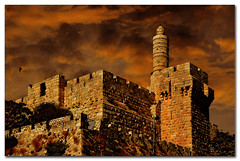
Hebrews...I can say nothing but "Wow!"
I don't know who wrote Hebrews, but it is obviously a word from God. The language is consistent with Scriptural writing. The thoughts are concise and correct. There is a super-natural power to the words, unlike a message written by man. The book has almost always been included in lists of inspired works since the first century (we call it the "canon"). So there is no doubt in my mind the book came from God.
The theme: JESUS IS BETTER!
At the end of the book, we read, "For the bodies of those animals whose blood is brought into the holy place by the high priest as an offering for sin, are burned outside the camp. Therefore Jesus also, that He might sanctify the people through His own blood, suffered outside the gate. So let us go out to Him outside the camp, bearing His reproach. For here we do not have a lasting city, but we are seeking the city which is to come" (Hebrews 13:11-14). Here is a call to come out of Jerusalem. The Hebrew men and women who read this letter were to leave behind the Law of Moses and look forward to the city built above - Heaven. Wow! Here is a call to go outside the walls of Jerusalem (the confines of Israelite custom and law) to be with Jesus, who is just plain better.
God bless,
Nathan
Tomorrow's Reading: Mark 1-3
Hebrews...I can say nothing but "Wow!"
I don't know who wrote Hebrews, but it is obviously a word from God. The language is consistent with Scriptural writing. The thoughts are concise and correct. There is a super-natural power to the words, unlike a message written by man. The book has almost always been included in lists of inspired works since the first century (we call it the "canon"). So there is no doubt in my mind the book came from God.
The theme: JESUS IS BETTER!
- Jesus is better than Angels - A better Messenger (Hebrews 1-2)
- Jesus is better than Moses - A better Apostle (Hebrews 3:1-4:13)
- Jesus is better than Aaron - A better High Priest (Hebrews 4:14-7:28)
- Jesus brought a better Covenant - A better Sacrifice (Hebrews 8-10)
- Jesus brought better Promises - A better Hope (Hebrews 11-12)
- Conclusion: Our Response of Faith (Hebrews 13)
At the end of the book, we read, "For the bodies of those animals whose blood is brought into the holy place by the high priest as an offering for sin, are burned outside the camp. Therefore Jesus also, that He might sanctify the people through His own blood, suffered outside the gate. So let us go out to Him outside the camp, bearing His reproach. For here we do not have a lasting city, but we are seeking the city which is to come" (Hebrews 13:11-14). Here is a call to come out of Jerusalem. The Hebrew men and women who read this letter were to leave behind the Law of Moses and look forward to the city built above - Heaven. Wow! Here is a call to go outside the walls of Jerusalem (the confines of Israelite custom and law) to be with Jesus, who is just plain better.
God bless,
Nathan
Tomorrow's Reading: Mark 1-3
Friday, May 1, 2009
Philippians: Trash Day
 Today is trash day. I go around the house consolidating the various trash bins into a single trash bag. I take the bag out to the street and leave it for the workers who I pay to pick it up every week. Everything in the trash bag is completely meaningless to me. I can't even tell you what's in it, really. It's rubbish, and it's disgusting. I want it out of my house and out of my life.
"I count all things to be loss in view of the surpassing value of knowing Christ Jesus my Lord, for whom I have suffered the loss of all things, and count them but rubbish so that I may gain Christ..." (Philippians 3:8).
Paul compared "all things" in his life against the "value of knowing Christ." As he weighed these two things, he realized that EVERYTHING in his life was expendable next to his relationship to the Lord. If he put "all things" in his life (his earthly relationships, his money, his knowledge, his experiences) on side 1 of a scale and his relationship with Christ on side 2, side 2 would drop like a rock flinging all the contents of side 1 off the scale! There's no comparison.
What kinds of things should we count as rubbish? Certainly past sinful activities. We obviously need to trash the old man of sin. But what about past achievements? What about the "good" things we've done? I have worked hard for the Lord. I have studied hard at school. I have earned awards at work. I have become a deacon or an elder or a teacher. I am recognized in the world and in the church as a person of integrity. Aren't these wonderful things? Shouldn't I hold on to these things? Paul would say "no." Paul said, "I do not regard myself as having laid hold of it yet; but one thing I do; forgetting what lies behind and reaching froward to what lies ahead, I press on toward the goal for the prize of the upward call of God in Christ Jesus" (Philippians 3:13-14). Paul had done much good and evil in his past. He's content to forget the past in the sense that he doesn't hold on to those things. He constantly looks to the future. Every day was trash day for Paul. He continually unloaded the baggage of his life. He could run faster and farther without all that rubbish, and when he reached his goal I'm convinced he never thought again about all the rubbish he left behind on earth!
God bless,
Nathan
Tomorrow's Reading: Hebrews 1-6
Thursday, April 30, 2009
Ephesians: Renovating This Old House
 When Bekah and I signed the papers on our first house, we already knew there were certain renovations that needed to be made. The hall bathroom had a rotten spot on the floor near the bathtub where water had been leaking. There were no lights in the living room, so we decided to install recessed lighting. There were no lights in the attic, so we installed lighting up there. Over the next few years we would paint the entire house, paint the kitchen cabinets, replace the kitchen floor, completely remodel the hall bathroom, and finally replace all the carpet throughout the entire house. It was a lot of work.
I couldn't have done it all at once; I didn't have the time, energy, or money to do it all at once. But slowly and surely we made that house better. Of course, things broke here and there. Toilets needed fixing, the kitchen faucet needed replacing, and a huge leak appeared in the rusted-out chimney cap. We had to deal with each of these problems as they came up. Some were higher priority than others. But they all needed work.
Paul wrote to the Ephesian brethren and said the Christian life needs renovation. It needs to be renewed (Ephesians 4:23). There is an old man of sin which must be cleaned up. We used to walk "as the Gentiles also walk, in the futility of their mind, being darkened in their understanding, excluded from the life of God because of the ignorance that is in them, because of the hardness of their heart; and they, having become callous, have given themselves over to sensuality for the practice of every kind of impurity with greediness" (Ephesians 4:17-19).
Each of us is a house in need of repairs. Some of us just need to understand the FACT we need work done on the house! How many times did Bekah have to tell me that something needed to be done in the house before I really came to terms with it? I might think, "That toilet is really not leaking badly enough yet." Until I AGREE that there is work to be done, I won't do the work.
 Some of us understand there is work to be done, but we prefer to remain in the dark about WHAT needs to be done. We think ignorance is bliss. If I think about it too hard, I might realize some specific problems in my life, but as long as I don't think about it I can always say, "I guess I never thought about it." Unfortunately, Paul says we are "excluded from the life of God because of the ignorance."
So...let's think about renovating this old house. I know I need to change some things...what do I need to change?
- Lying? Renovate by learning to speak truth (4:25)
- Anger? Renovate by learning to deal with the anger in wholesome ways (4:26)
- Stealing? Renovate by learning to work hard, earn money, and give (4:28)
- Filthy or Evil Speaking? Renovate by learning to edify and build up with my tongue (4:29)
- Bitterness, Wrath, Anger, Clamor, Slander, Malice? Renovate by learning kindness, tenderness, and forgiveness (4:31-32)
God bless,
Nathan
Tomorrow's Reading: Philippians
Wednesday, April 29, 2009
2 Timothy & Titus: What is "Sound Doctrine"?
 First, what is "doctrine"? There seems to be a distinction between "doctrinal issues" and "moral issues" these days. Many think "doctrinal issues" include such topics as divorce, taking the Lord's Supper, praying, fasting, musical instruments in worship, the head covering (1 Corinthians 11), spiritual gifts, etc. In fact, all of these things ARE doctrinal, but doctrine is not limited to these things. "Doctrine" simply means "teaching." That's it. There is no difference between the words. Everything in Scripture is "teaching" isn't it? The New American Standard Bible says, "All Scripture is inspired by God and profitable for teaching..." (2 Timothy 3:16). The New King James Version on the same verse: "All Scripture is given by inspiration of God, and is profitable for doctrine..." Teaching is doctrine and doctrine is teaching. When someone says, "I have a doctrinal question," he has probably pigeon-holed a certain set of teaching in his mind as "doctrine." He is probably about to ask a question about a topic such as found in the list above. But let's attempt to use Bible words in Bible ways. Otherwise we will end up with a FALSE doctrine!
Second, what is "sound doctrine"? In our reading today we find, "But as for you, speak the things which are fitting for sound doctrine" (Titus 2:1). The word "sound" means to be healthy or whole. To be "sound of mind and body" means your head and body are working like they are supposed to work. To speak "sound doctrine" is to teach God's teachings as they are supposed to be taught. We speak the WHOLE counsel of God. We don't change the teaching.
But Titus goes on in the chapter to define some items of study under "sound doctrine." What is he going to list? Will it be lectures on grace, faith, or justice? Will he tackle the worship of the church? Let's scan through the rest of Titus 2 to see what is included in "sound doctrine."
Verse 2 - teach the older men to be "temperate, dignified, sensible, sound in faith, in love, in perseverance"
Verse 3 - teach the older women to be "reverent in their behavior, not malicious gossips nor enslaved to much wine, teaching what is good"
Verse 4-5 - teach the younger women to "love their husbands, to love their children, to be sensible, pure, workers at home, kind, being subject to their own husbands"
Verse 6-8 - teach the younger men to be "sensible; in all things show yourself to be an example of good deeds, with purity in doctrine, dignified, sound in speech which is beyond reproach"
And so on it goes. These are moral teachings. This is pure doctrine! Titus was to preach these things, and we should follow his lead today in teaching every age group what they need to DO in service to God. In all things, our character and actions should glorify the Father, Son, and Holy Spirit!
God bless,
Nathan
Tomorrow's Reading: Ephesians
Tuesday, April 28, 2009
1 Timothy: Foremost of Sinners
 What if I always kept in the front of my mind that I have been immoral, immature, and rebellious against my God? The apostle Paul has to be one of the strongest human examples of Christ there has ever been. And yet, in writing to his special friend Timothy (his son in the faith), he wrote these words:
It is a trustworthy statement, deserving full acceptance, that Christ Jesus came into the world to save sinners, among whom I am foremost of all. Yet for this reason I found mercy, so that in me as the foremost, Jesus Christ might demonstrate His perfect patience as an example for those who would believe in Him for eternal life. Now to the King eternal, immortal, invisible, the only God, be honor and glory forever and ever. Amen.What if I had a heart like Paul? How could that change my perspective?
- 1 Timothy 1:15-17
1. I would have a better appreciation for God's amazing grace. I think we see this in Paul's statement above. Look at the praise Paul gives to God in this little paragraph! He is completely appreciative of his salvation.
2. I would use my life to better glorify God. If I don't have an appreciation for how LOW I am ("such a WORM as I"), I won't have an appreciation for how HIGH God is. But when I see myself as a creature of bad habits and sinful, I will reach out to my Savior to depend on Him and praise Him.
3. I would want to share my story with others. Sometimes we scorn the idea of giving testimonies. But isn't that what Paul does right here? He uses his life as an example for others. He doesn't gloat about the "good old days" when he was into sinful activities. He doesn't tell his story as if he enjoys it. But he tells it as a warning to others - and an encouragement to others. "If God can save me, He can save you, too!"
4. I would not look down on people in the world. I would appreciate their struggles with sin, even if they struggle with sins with which I've never wrestled. I know I have my own problems! I would be more interested in reaching out to them and bring them to the great Healer.
I'm going to try to go forward remembering I living among sinners...among whom I am the foremost of all.
God bless,
Nathan
Tomorrow's Reading: 2 Timothy & Titus
Subscribe to:
Posts (Atom)


 Posts
Posts

